Assessing Adaptation and Resilience Opportunities in Public Markets: Mapping SDG Data to Belem Indicators

The Climate Adaptation Investment Gap in a Post 1.5°C World
The Paris Agreement, adopted in 2015, mainstreamed global climate action. Climate mitigation activities have been prioritized by the corporate and investment community, given the urgency to control emissions, while climate adaptation measures have taken the back seat. A recent joint report by the Global Center on Adaptation (GCA) and the Climate Policy Initiative (CPI) estimates that in 2021-2022, global climate finance reached USD 1.3tr globally yet only 5% of that total was allocated to adaptation activities.
The intention of the Paris Agreement was always multifaceted: its goals included both mitigating the worst impacts of climate change by pursuing efforts to limit the temperature increase to 1.5°C and investing in adaptation to decrease our collective vulnerability to climate-related hazards and risks already occurring.
Recent climate hazards illustrate why both mitigation and adaptation are needed. Severe heat waves in North America, the United Kingdom, and the European Union; extreme flooding in China; and a prospective El Niño that could intensify flooding and drought all point to the types of risks that climate mitigation strategies seek to address. Adaptation, on the other hand, helps communities, economies, and businesses manage the impacts already unfolding. In Europe, limited adaptive capacity to heat waves and related wildfires has contributed to significant social and financial consequences.
Adaptation and Resilience as an Investment Opportunity
The Intergovernmental Panel on Climate Change (IPCC) defines “adaptation” as “the process of adjustment to actual or expected climate and its effects” and defines “resilience” as the “capacity of social, economic and environmental systems to cope with a hazardous event or trend or disturbance, responding or reorganizing in ways that maintain their essential function, identity and structure while also maintaining the capacity for adaptation, learning and transformation.”
Investors are quickly realizing the importance of climate physical risks and their portfolio exposure to climate hazards (as discussed in our 2026 study Resilience at Risk), but this is only one aspect of a potential climate investment thesis. Further discussions around climate adaptation, its nuances, and its opportunities are increasingly becoming pressing and material.
Considerations of Adaptation and Resilience (A&R) Investments:
1. Direct products, services, or operations that use A&R solutions
Adaptation and resilience (A&R) investments can include allocation to A&R products and services and/or operations that utilize selected A&R solutions (Table 1).
Table 1: Examples of Adaptation and Resilience Investments
| Risk Example | Products & Services | Operations | |
| Climate Physical Risk | Water stress | Water-efficient irrigation technology | Adopting regenerative agriculture techniques |
| Climate Transition Risk | Deforestation-related product bans | Deforestation-free chocolate | Utilizing E-DNA technology to check supplier origins |
2. Context specific
Adaptation and resilience investments are also very context specific. If an investor’s portfolio primarily consists of automobiles and food products, the adaptive activities invested in should mirror the physical and transition risks most inherent to the portfolio. For example, in the automobile industry the main investment opportunities would be in circularity, and for food products, the main opportunities would be in regenerative agriculture.
An Overview of Adaptation and Resilience (A&R) Global Goals, Targets, and Indicators
The lack of standardized targets and indicators for what can be categorized as an A&R activity has been a challenge for those investors and corporates looking to allocate capital to those activities, yet some significant progress has been made on this front over the past few years.
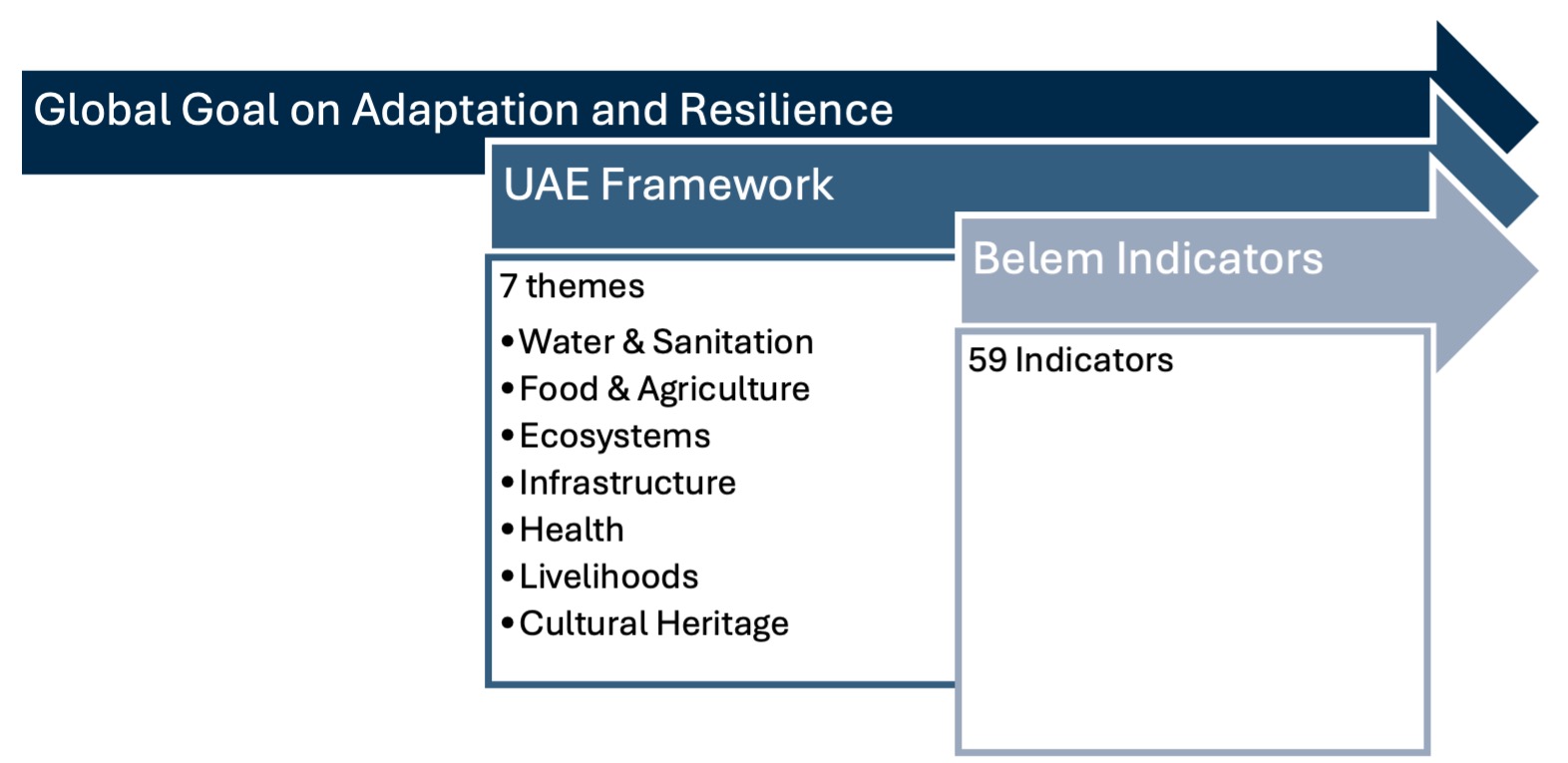
The Global Goal of Adaptation (GGA) was established in 2015 as part of the Paris Agreement, with the “aim to enhance adaptive capacity, strengthen resilience, and reduce vulnerability to climate change.” In 2023, the UAE Framework for Global Climate Resilience was adopted to translate the GGA goals into 11 targets: seven thematic and four dimensional. In 2025, the Belem Adaptation Indicators were introduced to operationalize the UAE Framework Targets into 59 unique indicators (Figure 1).
Figure 1: The Throughline between the Global Goal of Adaptation and Belem Adaptation Indicators
Source: ISS STOXX Research Institute, adapted from United Nations Foundation
In the next section, we have mapped the GGA goals, UAE targets, and Belem indicators to the Sustainable Development Goals (SDGs), to help assess public companies’ A&R performance.
Case Study: Textiles & Apparel – SDG 15 Life on Land – Deriving Adaptation Insights from SDG Impact Data
The Textiles & Apparel industry has both a large impact on land and high dependence on certain soft commodities, making SDG 15: Life on Land highly relevant for this industry.
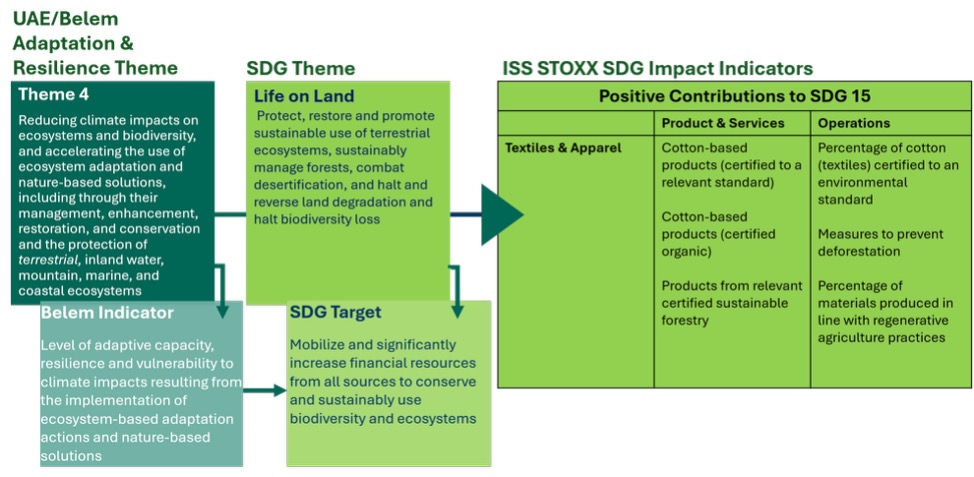
The UAE Framework for Resilience calls for a reduction in climate impacts on terrestrial ecosystems and biodiversity while the Belem Adaptation Indicators focuses on the specific adaptation outcomes that lead to enhanced ecosystem resilience. The ISS STOXX Research Institute mapped these goals and indicators to existing SDG 15 sub-targets (Figure 2).
Figure 2: From Belem to ISS STOXX SDG Indicators
Source: ISS STOXX Research Institute, Center for Climate and Energy Solutions
In alignment with what the Belem Indicators dictate as “adaptive outcomes” for resilient ecosystem services, the Textiles and Apparel Industry can focus on two indicators related to SDG 15: 1) products and services in this industry that transition from synthetic, oil-based materials such as polyester to regenerative and organic certified materials such as cotton; and 2) upstream operations that focus on regenerative agriculture outcomes and downstream operations that adhere to procurement standards that support certified materials that do not disrupt the resilience of terrestrial ecosystems.
The SDG Impact Rating solution shows that, at an industry level, most of the issuers in the Textiles and Apparel industry demonstrate either no net impact or at least a limited contribution to SDG 15 within their operations. At the same time, when considering products and services’ impact, the industry has a largely limited obstruction profile, with more than 60% of their impact classified as significant or limited obstruction to SDG 15 Life on Land. (Figure 3).
Figure 3: SDG 15 Impact by Operations and Products & Services
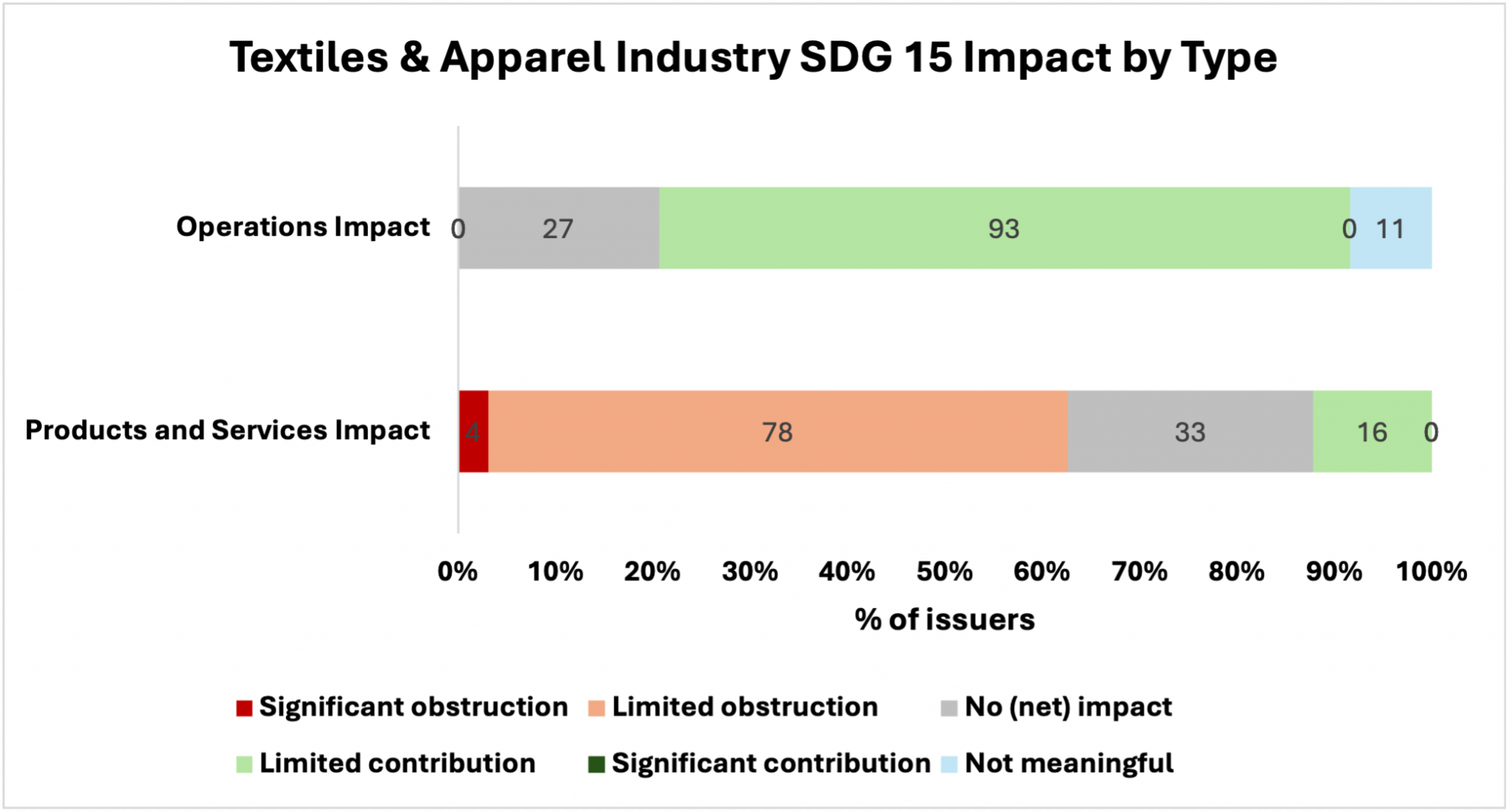
Note: Number of issuers = 131; “not meaningful” is defined as an indicator(s) that has been assessed as not impactful for that industry classification.
Source: ISS STOXX Research Institute, SDG Impact Rating
Operations
The industry’s general commitment to procuring cotton that is aligned with agricultural practices certified to environmental standards, such as water preservation, pesticide management, climate mitigation, and low soil disturbance, can help explain the industry’s relatively positive impact profile on its operations (Figure 4).
Figure 4: Textiles & Apparel Operations’ Impact on SDG 15
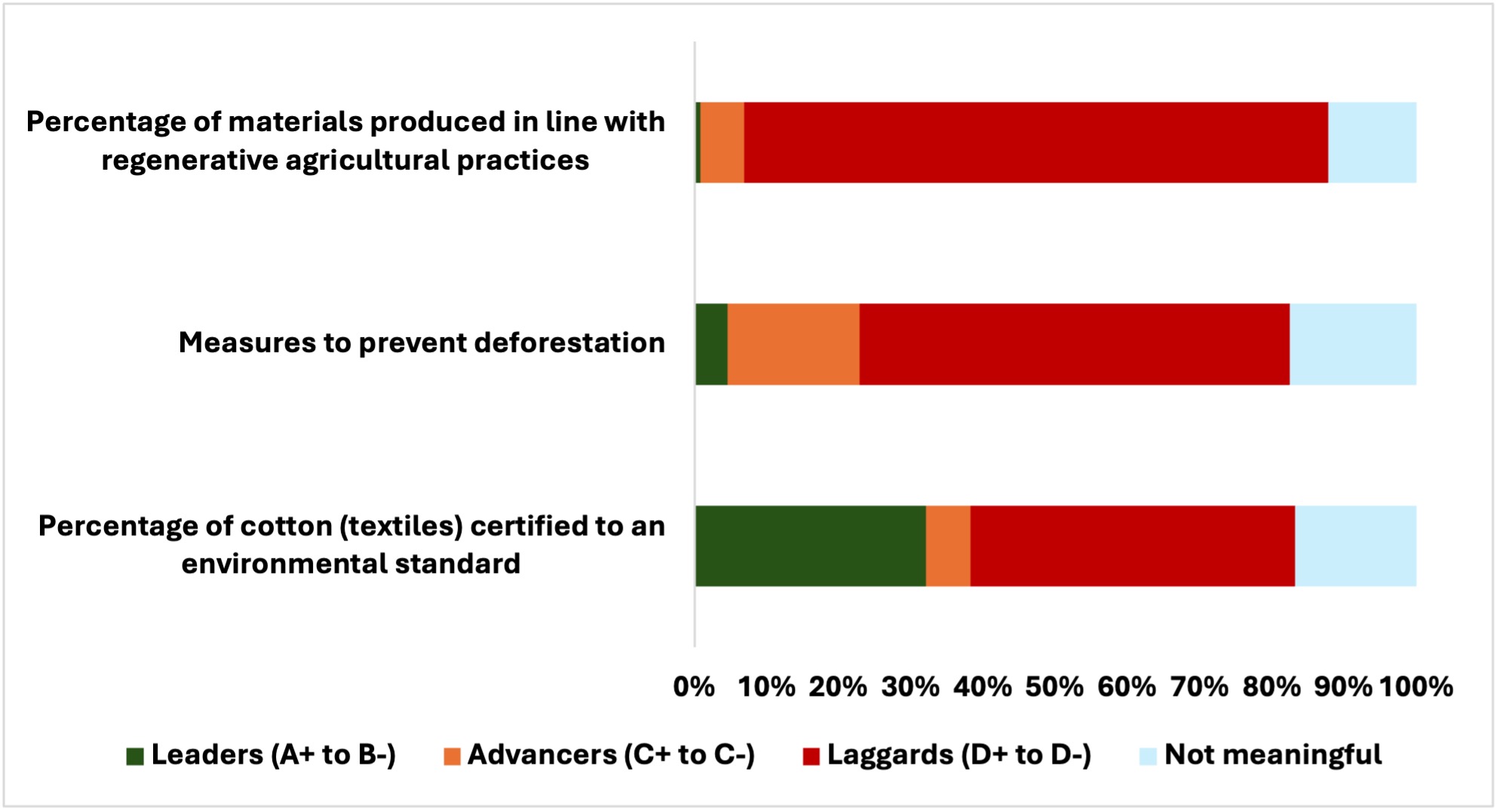
Note: Number of issuers = 131; “not meaningful” is defined as an indicator that has been assessed as not impactful for that industry classification.
Source: ISS STOXX Research Institute, Corporate Rating
Investors interested in adaptation and resilience opportunities could positively screen for issuers in this industry that are leading or advancing in operational practices that lead to positive ecosystem-resilient outcomes in their direct operations and supply chains.
Products & Services
Product and Services-related contributions to Life on Land are measured by the percentage of net sales shares of an issuer’s product portfolio. The analysis showed that only 8% of the Textiles & Apparel industry (11 issuers out of 131 in the universe) have net sales that have limited contributions to SDG 15, and, even then, these positive net sales account for only 5% or less of their total sales. All the issuers with positive net sales contributions include products that include sustainable forestry certification (Figure 5).
Figure 5: Issuers with Positive Products & Services Associated with SDG 15 – Life on Land
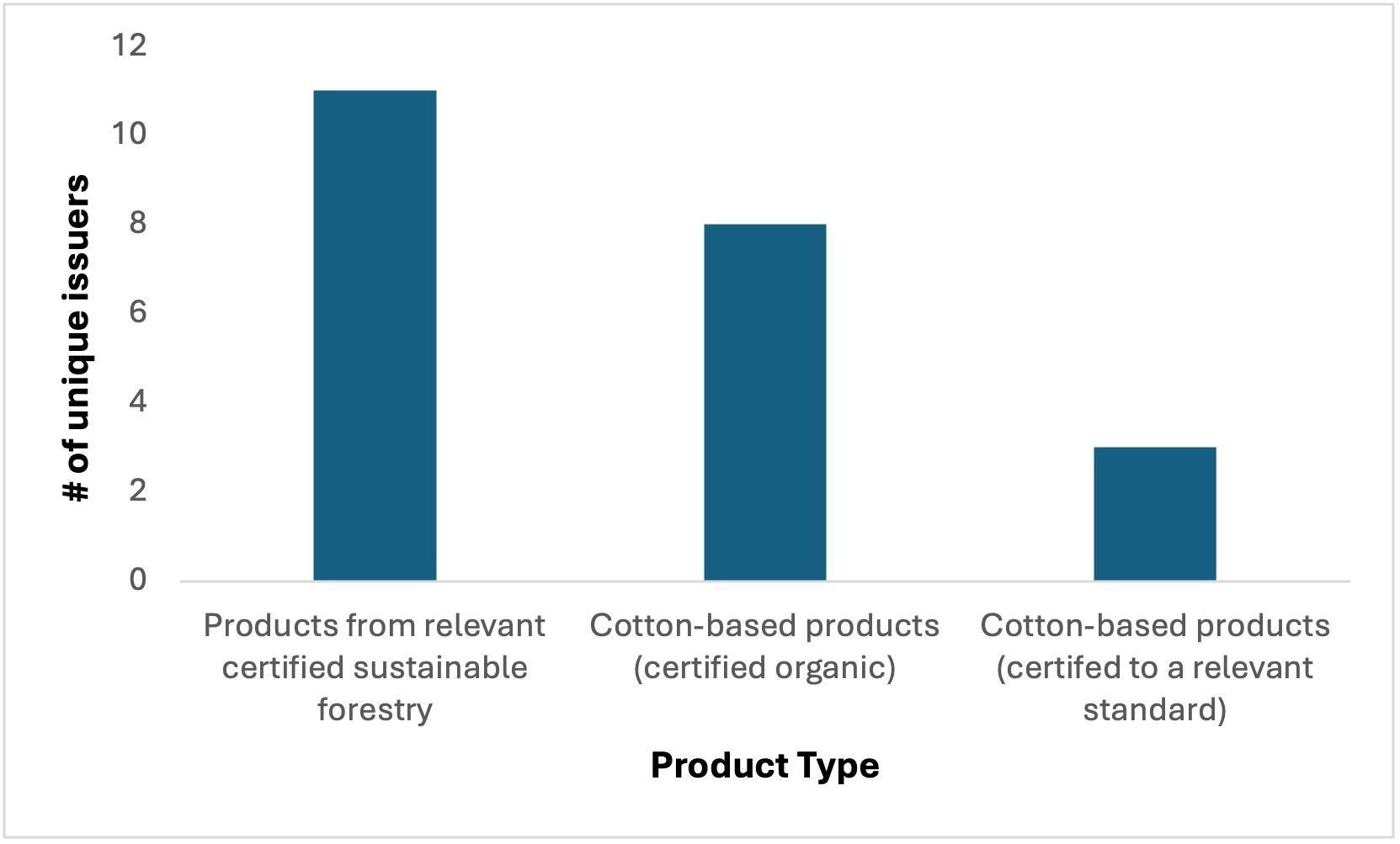
Note: Number of issuers with limited contribution to SDG 15 = 11
Source: ISS STOXX Research Institute, SDG Impact Rating, and SDG Solutions Assessment
SDG Impact Data Can Provide Insights into an Issuer’s A&R Performance
The world continues to face the effects of climate change and nature loss through the increased frequency and severity of extreme weather events. While global investments in adaptation and resilience (A&R) have been marginal in comparison to those in climate mitigation efforts, there is increasing investor interest in understanding the opportunities around activities that can help economies and businesses adapt and thrive in a changing physical world. The UAE Targets and the Belem Indicators offer investors a framework to explore these opportunities, and the Sustainable Development Goal dataset provides insights around specific issuer-level performance on A&R activities. By looking at both companies’ operations and products and services, investors can begin to assess how adaptive and resilient an issuer is to climate- and nature-related risks, for various investment use cases.
Your Feedback Matters
Let us know how this research resonated with you. Your input helps us develop content that resonates with investors across the globe.

Authored By
Caitlin Harris, Research Lead, ISS STOXX Research Institute
Mirtha Kastrapeli, Managing Director and Global Head, ISS STOXX Research Institute
Contributors
Brodie Houlette, Methodology Team Lead, ISS STOXX
Sophia Walsh, Methodology Specialist, ISS STOXX
Shashank Hariharnath Tripathi, Methodology Specialist, ISS STOXX
See More