Beyond the Checkbox: What a Decade of Succession Planning Tells Investors about Board Preparedness

Key Takeaways
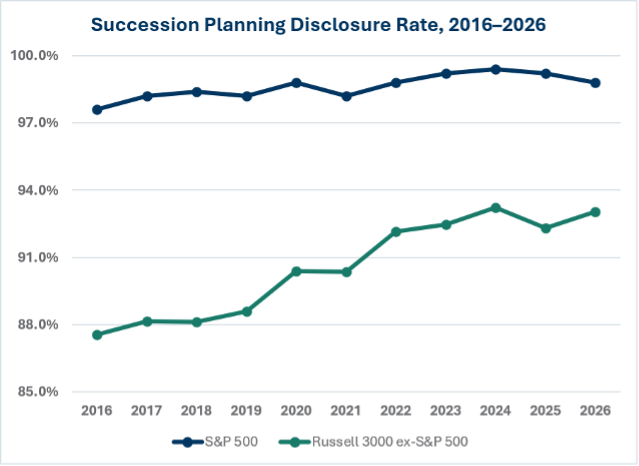
- Succession planning disclosure is nearing a ceiling among large U.S. companies. Among S&P 500 companies, 98.8% disclosed a CEO and key executive succession plan in 2026, up from 97.6% in 2016, leaving little room for further gains.
- The broader U.S. market has also narrowed the gap. Disclosure among Russell 3000 companies outside the S&P 500 rose from 87.6% to 93.0% over the same period, narrowing the large-cap lead from 10.0 to 5.8 percentage points.
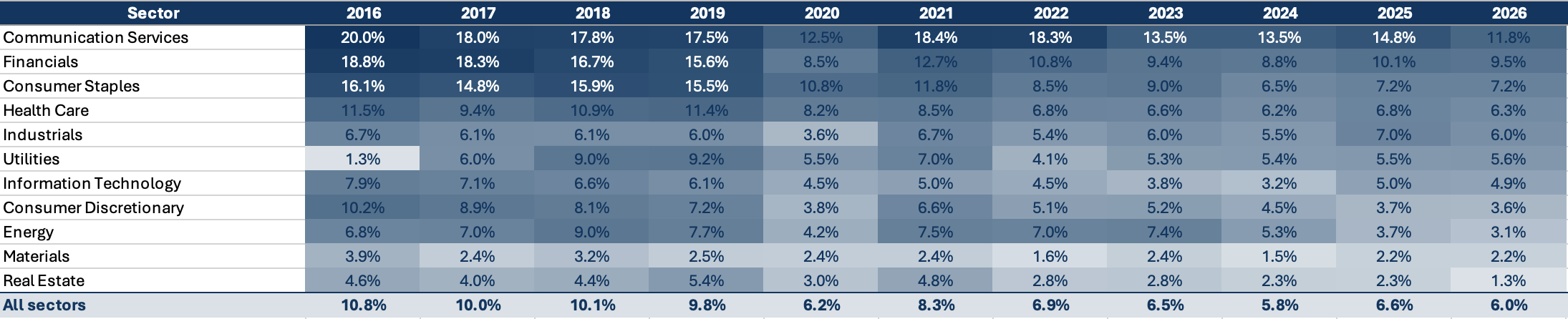
- Remaining non-disclosure in the U.S. market is concentrated in certain sectors. Communication Services (11.8%) and Financials (9.5%) have significantly higher non-disclosure rates than the 6.0% U.S. average, and Communication Services has ranked first or second every year since 2016.
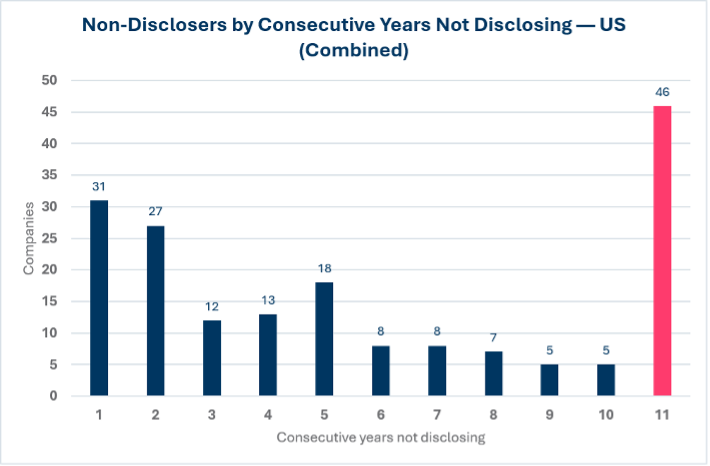
- Non-disclosure tends to persist. Of the 180 U.S. companies in the Governance QualityScore (GQS) universe that do not disclose a succession plan, 97 (54%) have not disclosed for at least 5 consecutive years, and 46 have not disclosed in any of the 11 years analyzed.
- Outside the United States, disclosure is improving but dispersion is wide. Disclosure rose in seven of the eight regions among companies tracked since 2022, yet country-level rates range from 16% in Sweden to 99% in South Africa.
- Governance-code coverage is associated with higher succession disclosure. Markets whose governance frameworks expressly address succession planning generally have higher company-level disclosure rates, while Sweden and Norway, whose codes do not contain comparable provisions, have the lowest rates studied. The relationship is not uniform, indicating that the nature and scope of the guidance, including whether smaller companies fall outside its application, and other market practices also matter.
- Market, rather than sector, appears to drive international differences. Differences within regions are often larger than differences between them, and sector patterns outside the United States run counter to those observed in the U.S. market.
- The focus may be shifting from whether a plan exists to how it is governed. In every market studied except the Nordics, between 10% and 36% of companies do not identify a board committee responsible for succession.
Introduction
CEO succession has become one of the most closely watched topics in corporate governance. Turnover at the top has reached historic levels: ISS STOXX Governance tracked an average of 490 CEO departures annually at U.S. publicly traded companies over the past three years, including approximately 50 per year among S&P 500 companies, and Russell Reynolds Associates’ Global CEO Turnover Index counted 234 CEO departures across major global indices in 2025, a second consecutive record. Although the pace of exits has eased in 2026, tenures continue to shorten; the average outgoing CEO tenure tracked by Russell Reynolds fell to 7.1 years in 2025.
Directors appear to recognize the stakes: the National Association of Corporate Directors’ 2026 Governance Outlook, based on a survey of more than 24,000 members, identified CEO succession planning as the board practice most in need of improvement. Yet gaps remain. A global survey of more than 700 governance professionals by Nasdaq found that 21% of boards still do not have a CEO succession plan.
For investors, succession is ultimately a question of board foresight and accountability. A succession plan needs to work on two horizons: supporting an orderly transition following a planned CEO departure and providing for leadership continuity and replacement when a departure is sudden or unexpected.
As noted in the recent ISS STOXX article, U.S. Governance in Transition, investors may increasingly look to director elections as an avenue for accountability if other shareholder mechanisms become less available. How boards prepare for and oversee both planned and emergency succession, and what they disclose about those processes, is likely to be an important part of that assessment.
This article examines the state of succession planning disclosure using the ISS Governance QualityScore. It analyzes approximately 3,000 U.S. companies in the S&P 500 and Russell 3000 over 11 annual snapshots from 2016 to 2026, and approximately 2,700 companies across 8 international markets from 2022 to 2026. It also considers which board committees are responsible for succession.
The data discussed in this report captures whether companies disclose that a formal CEO and key executive succession plan exists, not the quality or effectiveness of the underlying plan. Some of the information needed to assess that quality may reasonably remain outside public disclosure, including details concerning potential successors and their readiness. That information gap can become particularly important when a sudden leadership transition tests the strength of the succession arrangements. The disclosure data and CEO-transition-process-related information can therefore provide investors with a basis for more targeted engagement on succession governance before such a transition occurs and, where relevant, broader consideration of board accountability.
Succession Disclosure in the United States
A Decade of Steady Progress
ISS Governance QualityScore data shows that disclosure of a formal CEO and key executive succession plan is now close to universal among the largest U.S. companies. Among S&P 500 companies, disclosure rose from 97.6% in 2016 to 98.8% in 2026, a level that leaves little room for further improvement (Figure 1).
Figure 1: Succession Planning Disclosure Rate, 2016–2026
Source: ISS Governance QualityScore, November 2026
Most of the movement has come from the broader market. Among Russell 3000 companies outside the S&P 500, disclosure rose from 87.6% to 93.0%, narrowing the large-cap lead from 10.0 to 5.8 percentage points.
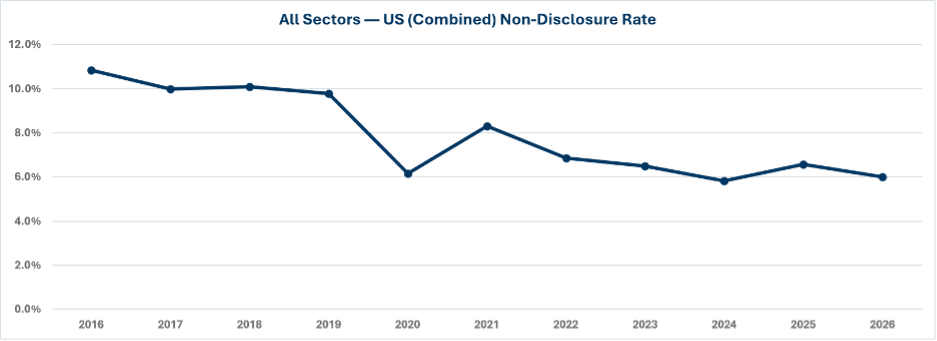
Company-level data supports the trend: of 1,738 companies present in both 2016 and 2026, 111 began disclosing a succession plan over the period, while only 14 stopped. Across the combined U.S. universe, the share of companies not disclosing a plan fell from 10.8% to 6.0% (Figure 2).
Figure 2: Non-Disclosure Rate, U.S. Companies (S&P 500 and Russell 3000), 2016–2026
Source: ISS Governance QualityScore, November 2026
This suggests that disclosing the existence of a succession plan has become a baseline expectation rather than a differentiator. That raises a natural question: where does non-disclosure persist, and why?
Where Non-Disclosure Persists
Remaining non-disclosure is concentrated in a small number of sectors. In 2026, Communication Services and Financials had the highest non-disclosure rates, at 11.8% and 9.5%, against a 6.0% average for the combined U.S. universe; both differences are statistically significant. Within Financials, banks stand out at 12.7%. Communication Services has ranked first or second for non-disclosure in every year since 2016 (Figure 3).
Figure 3: Non-Disclosure Rate by Sector, U.S. Companies, 2016–2026
Source: ISS Governance QualityScore, November 2026
Both sectors have nonetheless improved substantially, from 20.0% in Communication Services and 18.8% in Financials in 2016. The persistence of their relative ranking, however, suggests that sector-specific factors may continue to shape disclosure practices, even as overall levels rise.
A Persistent Minority
The companies that do not disclose a succession plan tend to remain non-disclosers. Of the 180 U.S. companies without a disclosed plan in 2026, 97 (54%) have not disclosed for at least 5 consecutive years, and 46 have not disclosed in any of the 11 years analyzed (Figure 4).
Figure 4: Current U.S. Non-Disclosers by Consecutive Years Not Disclosing
Source: ISS Governance QualityScore, November 2026
For this group, non-disclosure appears to reflect a settled practice rather than a temporary gap. In a market where disclosure has become the norm, long-standing non-disclosure may offer a specific entry point for stewardship teams seeking to understand how these boards approach leadership continuity.
Succession Disclosure outside the United States
Broad Improvement, Wide Dispersion
Governance frameworks provide important context for the company-level differences. Markets whose governance codes expressly address succession planning generally have higher disclosure rates, although the relationship is not uniform. Differences in the nature and scope of the guidance, including whether smaller companies fall outside its application, as well as other market practices, may also contribute to the variation.
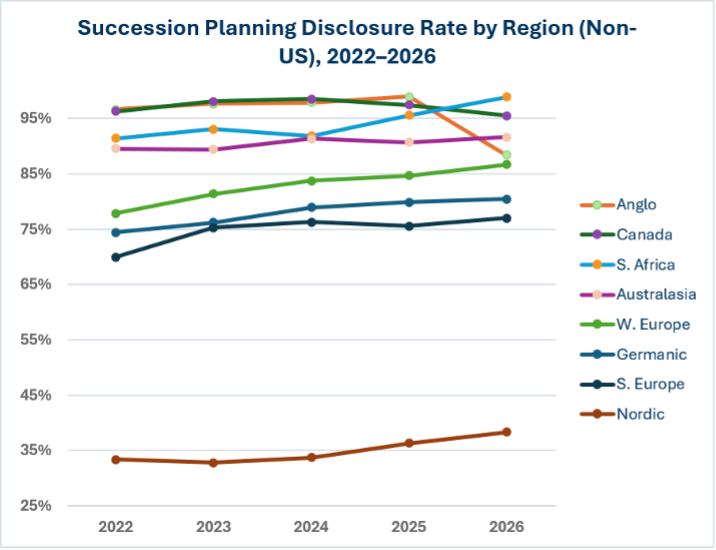
Against this backdrop, outside the United States, the picture is one of improvement from more varied starting points. Across the eight regions where this data point applies, disclosure improved between 2022 and 2026 in seven of the eight regions among companies tracked over the full period. The largest gains came in Western Europe (+8.3 percentage points), South Africa (+7.7), Southern Europe (+7.2), and the Germanic markets (+5.1). Smaller Canadian companies were the only group to decline, by 0.9 percentage points (Figure 5).
Figure 5: Succession Planning Disclosure Rate by Region, 2022–2026
Source: ISS Governance QualityScore, November 2026
Tracking the same companies over time matters. In the United Kingdom and Ireland (Anglo), the headline disclosure rate fell from 98.9% in 2025 to 88.4% in 2026, but this reflects index changes that added 184 companies with lower disclosure rates. Among the 337 Anglo companies tracked throughout the period, disclosure rose from 98.2% to 99.7%.
Country Matters More Than Region
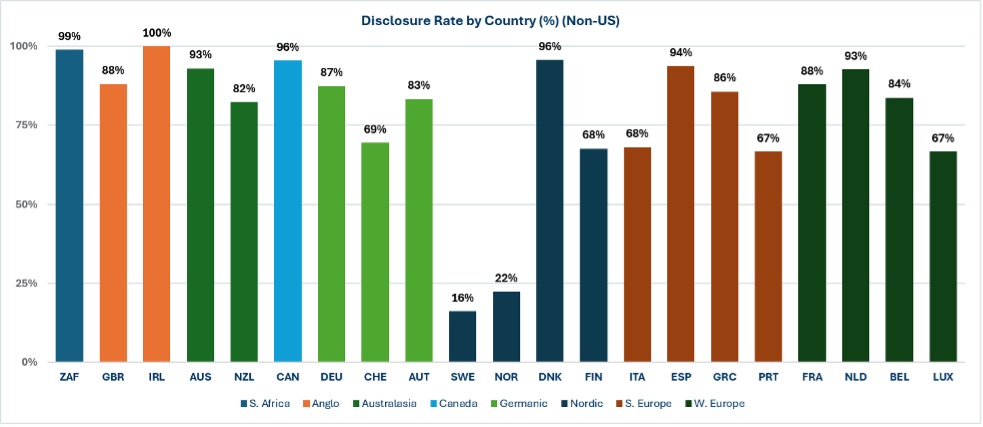
Country-level data shows how wide the range is. South Africa (99%), Canada (96%), Denmark (96%), Spain (94%), Australia (93%), and the Netherlands (93%) disclose at or near the levels of large U.S. companies. At the other end, Sweden (16%) and Norway (22%) stand apart. Differences within regions are often larger than those between them: Denmark and Sweden are 80 percentage points apart, Spain and Italy (68%) 26 points, and Germany (87%) and Switzerland (69%) 18 points (Figure 6).
Figure 6: Succession Planning Disclosure Rate by Country, 2026
Source: ISS Governance QualityScore, November 2026
The Nordic markets offer one of the clearest examples of where differences in governance guidance coincide with differences in company disclosure. Sweden and Norway, whose governance codes do not contain comparable express succession-planning provisions, have the lowest disclosure rates in the study, at 16% and 22%, respectively. Denmark, whose governance framework expressly addresses succession planning, is at 96%. Sweden’s shareholder-led nomination structure does not by itself explain its lower disclosure rate, as these committees primarily address board nominations rather than CEO succession.
The code framework therefore provides relevant context but does not fully explain the variation. Differences in code coverage, company populations, and broader market disclosure practices may also contribute.
The nature of non-disclosure also differs. In Southern Europe, 68% of non-disclosing companies state explicitly that they do not have a succession plan, consistent with comply-or-explain expectations under local governance codes, whereas in most other markets non-disclosure generally means silence.
From Disclosure to Oversight
If disclosing that a plan exists has become a baseline expectation in many markets, the next question for investors may be how responsibility for that plan is assigned and overseen. ISS Governance QualityScore data on which board committee is responsible for succession points to wide variation. In 2026, 14% of S&P 500 companies and 19% of other Russell 3000 companies did not identify such a committee, compared with 10% in Canada and 16% in the United Kingdom and Ireland, and roughly one-third of companies in the Germanic and Southern European markets. In the Nordic markets, 68% did not identify a board committee responsible for succession.
As with succession-plan disclosure itself, however, the absence of an identified committee should not be read as evidence that the board does not oversee succession. Responsibility may sit with the full board or be structured differently across markets.
Committee disclosure can therefore provide insight into the governance architecture around succession but not necessarily the effectiveness of oversight. Identifying a responsible committee can clarify where accountability for the process sits, while a lack of clarity around responsibility may warrant further inquiry rather than indicate an oversight failure. These differences can help focus engagement on who owns the succession process, how frequently it is reviewed, and how the board prepares for both planned and emergency transitions.
Conclusion
The ISS STOXX data suggests that succession planning disclosure has largely matured among large U.S. companies and is improving across most international markets. Simply confirming that a plan exists may no longer distinguish well-governed boards from others. Disclosure that a plan exists should not be taken as evidence of its quality or the board’s preparedness for a leadership transition. Rather, coupled with other indicators, such as a long-tenured CEO with an outsized role in the company’s strategy and identity, founder leadership, or significant concentration of voting power, it can provide a starting point for identifying where further investor engagement may be warranted.
For investors, the more informative signals may lie elsewhere: in the persistence of non-disclosure among a minority of companies, in the wide dispersion across international markets, and in whether boards identify who is responsible for overseeing succession. These signals can help focus engagement with portfolio companies on which committee owns the process, how often the plan is reviewed, what emergency or interim arrangements are in place, and how internal candidates are developed.
Such engagement is particularly important because some of the information needed to assess the strength of a succession process may reasonably remain outside public disclosure. Investors may not know the identity or readiness of potential successors, but they can seek to understand how the board governs the process and prepares for both planned and unexpected transitions. Where material concerns remain unresolved, those considerations may form part of a broader assessment of board accountability.
As CEO turnover remains elevated and investors potentially place greater emphasis on director elections as an avenue for accountability, the quality of board oversight of leadership transitions is likely to attract increasing scrutiny. Companies that move beyond confirming the existence of a plan to explaining how it is governed may be better positioned to meet that scrutiny. Company disclosure provides one window into that preparedness; targeted issuer engagement can provide another.
About the Data: Disclosure is measured as the share of applicable companies that disclose a formal CEO and key executive succession plan in the ISS Governance QualityScore; rates are answer shares, not scores. U.S. data covers the S&P 500 and the remaining Russell 3000 constituents at annual November snapshots from 2016 to 2026 (December for 2016). International data covers eight markets at November snapshots from 2022 to 2026. Committee data covers 2023 to 2026. Sector classifications reflect current GICS assignments.
Note on 2020 Data: In the 2020 snapshot, 65 U.S. companies were recorded as disclosing a succession plan for that year only, between years of non-disclosure in 2019 and 2021. This pattern coincides with a change in how non-disclosure was coded in the underlying data. To correct for this, any 2020 reading that differed from both the 2019 and 2021 readings for the same company was set to the adjacent value (68 companies in total). The correction affects 2020 values only; figures for all other years, including the 2016 and 2026 end points, are unchanged.
Your Feedback Matters
Let us know how this research resonated with you. Your input helps us develop content that resonates with investors across the globe.

Authored By
ISS STOXX Governance
See More