U.S. Governance in Transition: Shifting Investor Sentiments and Implications for the Future

Key Takeaways
- The U.S. governance framework is entering a period of significant transition, with proposed SEC reforms potentially reshaping shareholder proposals, exempt solicitations, executive compensation disclosure, and say-on-pay voting. The 2026 ISS Global Benchmark Policy Survey results provide an indication of how investors may respond as that landscape evolves.
- Some long-established shareholder mechanisms may become less available. If proposed changes to shareholder proposals and exempt solicitations move forward, the mechanisms available to investors to engage, raise concerns, and communicate with companies could change significantly, potentially leading many investors to place greater emphasis on other avenues for accountability.
- Investor focus remains firmly on shareholder rights. The survey results suggest investors generally support weighing all factors in assessing re-incorporation decisions but place particular importance on preserving mechanisms that allow shareholders to hold boards and management accountable.
- Investors may adapt by placing greater future voting emphasis on director elections for accountability. As shareholder proposals and advisory say-on-pay votes potentially become less available, the survey results suggest that investors may increasingly look to director elections as avenues for expressing governance concerns through voting.
- Executive compensation disclosure and oversight could change substantially. The SEC’s proposed reforms would exempt many companies from existing compensation disclosure requirements and say-on-pay votes, a change that could affect a large portion of the U.S. market. The SEC estimates that approximately 81% of public companies would qualify for the proposed changes.
- Many investors will continue to expect accountability for pay decisions. Even in the absence of say-on-pay votes, most investor respondents to the survey supported some form of board-level accountability, particularly through compensation committee leadership. Half favored initially focusing accountability on the compensation committee chair and escalating only if concerns persist over multiple years, while 41% supported directing concerns toward compensation committee members more broadly from the start.
- Investors continue to value executive compensation transparency, while recognizing that commercial sensitivities on performance targets can be legitimate. Over 70 percent of investor respondents answered either that competitive harm may justify non-disclosure in certain circumstances—after considering the company’s specific explanation and facts on a case-by-case basis—or with retrospective disclosure.
- Investors are particularly skeptical of non-disclosure for relative performance metrics. Nearly 80% of investor respondents agreed that competitive harm is a less compelling rationale for withholding relative performance goals.
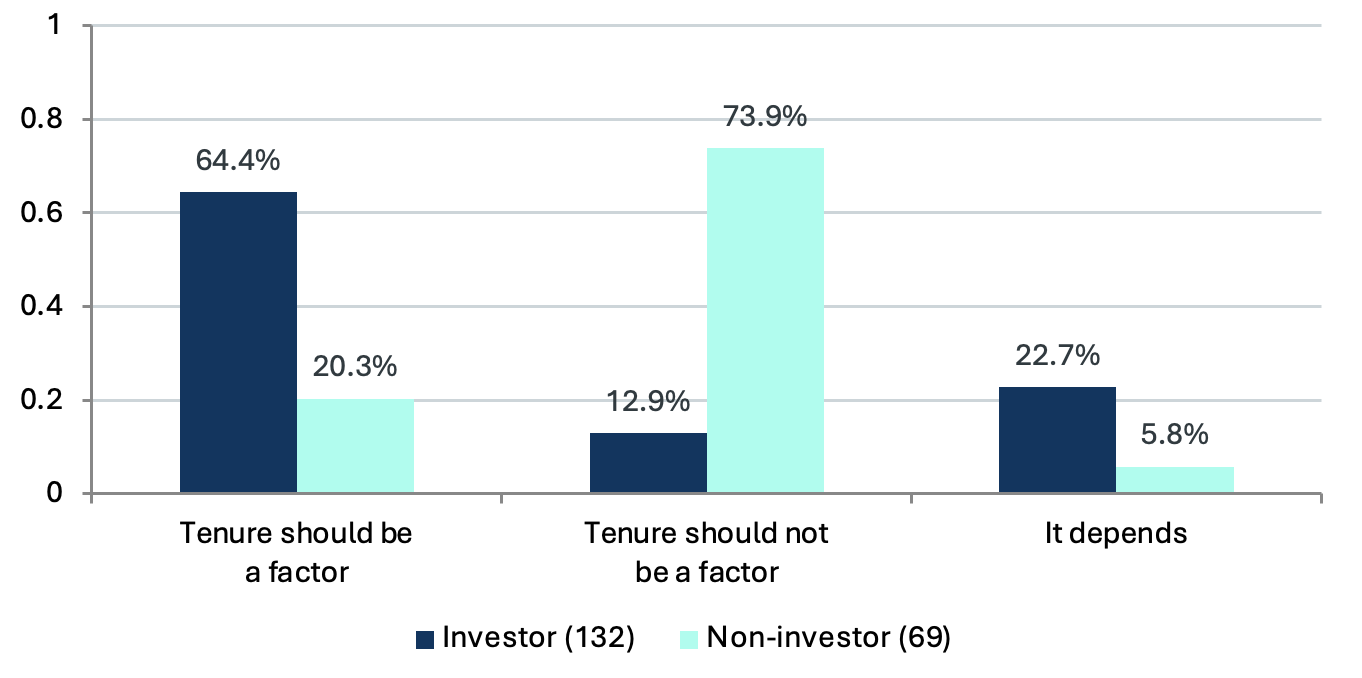
- As investors may increasingly look to directors for accountability, director independence is likely to receive greater scrutiny. Approximately 64% of investor respondents indicated that lengthy director tenure should be considered in independence assessments, even though this is not currently a standard market practice in the United States.
- Investors favor a holistic approach to board independence and tenure. Rather than using mechanical director tenure limits, respondents generally supported evaluating tenure and independence in the context of broader factors such as board refreshment, leadership structure, and long-term board tenure overlaps.
Introduction
The U.S. corporate governance landscape is entering a period of significant transition. In September, Dow Jones reported that the SEC had “moved forward with an effort to upend the process used by shareholders to communicate with management and influence a company’s direction.” That effort is part of a broader set of proposed regulatory changes that could reshape long-established mechanisms through which investors engage with companies and other shareholders, and are assured of certain levels of transparency, including shareholder proposals, exempt solicitations, executive compensation disclosure, and advisory say-on-pay votes.
The proposals also point to a potentially broader reconsideration of the regulatory framework underpinning shareholder rights. In discussing the SEC’s proposed rule on shareholder proposals, SEC Chair Paul Atkins framed the issue in terms of the balance between federal and state authority, noting that “as we experience an exciting period of increased competition among states for corporate domicile, there is no better time for the Commission to recognize the limits of its authority, relative to state law, for regulating shareholder proposals.”
While many of these changes are still proposals and their timing and final form remain uncertain, the direction of travel is becoming clearer. Investors in U.S. companies may soon find themselves operating in an environment where some long-established shareholder rights and investor engagement tools are less available, placing greater emphasis on board accountability and director elections.
How investors are responding to this changing landscape is therefore an increasingly important part of the governance debate. The 2026 ISS Global Benchmark Policy Survey provides an early indication of how a significant number of institutional investors are thinking about that changing landscape. Across issues ranging from shareholder rights and executive compensation to director accountability and independence, the results point to a common theme: investors appear focused not simply on preserving existing mechanisms, but on ensuring that meaningful avenues for accountability remain if those mechanisms change.
Shareholder Proposals and Shareholder Rights
SEC Steps Back from the Shareholder Proposal Process
A significant piece of this potential shift is the shareholder proposal process. The SEC has proposed rescinding Rule 14a-8 altogether, which establishes the federal framework governing the inclusion of shareholder proposals in company proxy materials.
If implemented, responsibility for regulating shareholder proposals could shift largely to individual states, depending on where a company is incorporated, requiring state legislatures and courts to develop new frameworks and potentially intensifying competition among incorporation jurisdictions. While the current framework is widely expected to remain in place through the 2027 proxy season, investors may need to prepare for a governance landscape that becomes increasingly fragmented across U.S. states.
Re-incorporation: Weighing Corporate Benefits and Shareholder Rights
Against this backdrop of potential shifts toward state-level governance, the survey offers an early indication of what investors may prioritize. As companies may evaluate potential changes to their jurisdiction of incorporation or governing documents, investors appear focused on balancing potential corporate benefits of any changes against any impact on shareholder rights.
The largest share of all respondents to the survey (i.e., investors and non-investors) favored assessing all material factors together, including both company benefits and any positive or negative effects on shareholder protections. However, investors were notably more likely than non-investors to place particular weight on changes that weaken accountability to shareholders.
Figure 1: Assessing Reincorporation Proposals: How Should Shareholder Rights Be Weighed?
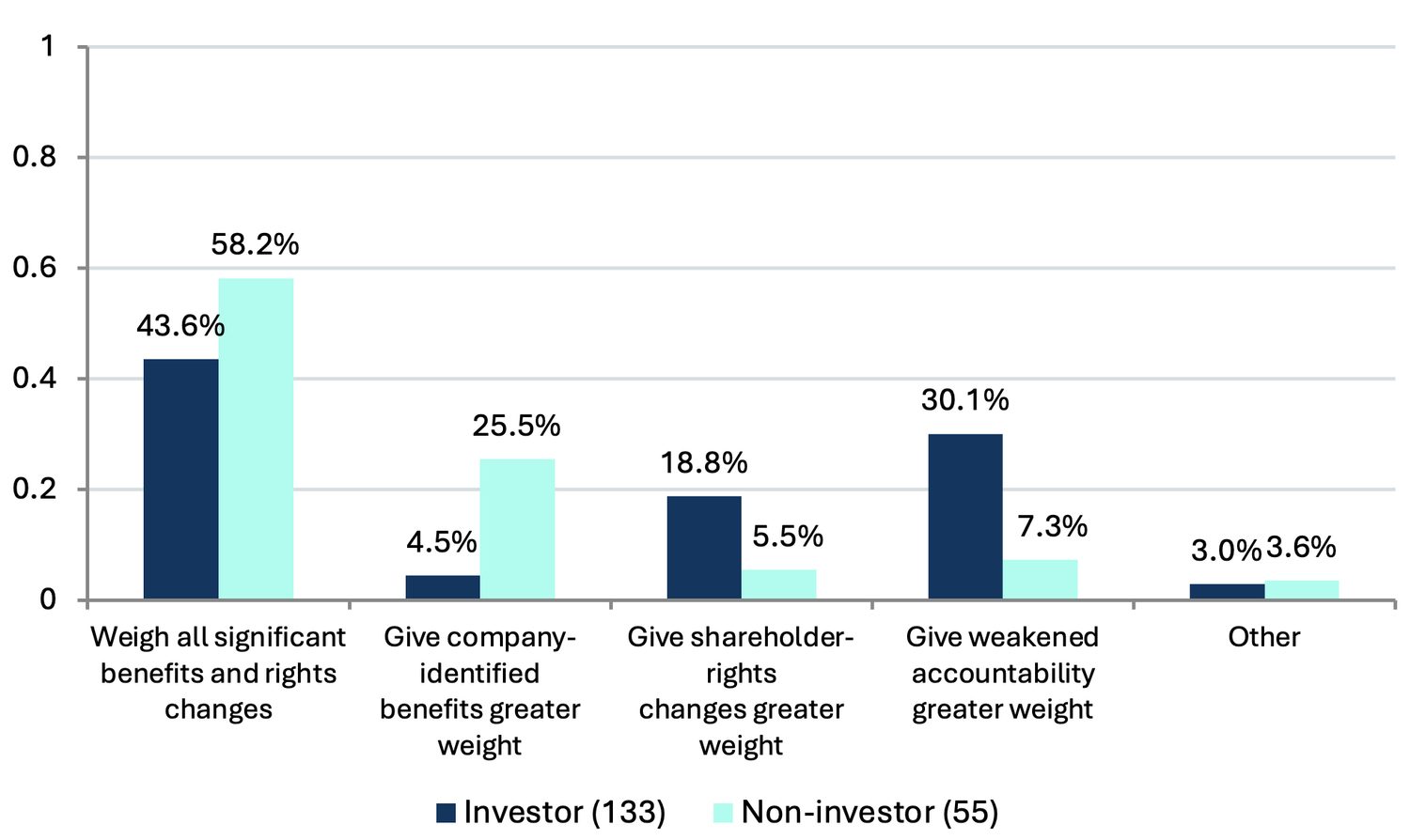
This suggests that while investors recognize that re-incorporations may offer certain benefits to the company, many remain focused on whether shareholder accountability is preserved in the process.
The Future of Exempt Solicitations
The potential reconfiguration of shareholder engagement extends beyond shareholder proposals and Rule 14a-8. The SEC has also proposed substantial changes to the exempt solicitation framework, which allows shareholders to publicly communicate their views on matters subject to a shareholder vote through filings made available on the SEC’s EDGAR platform, without conducting a full proxy solicitation. Previous reforms limited exempt solicitation filings to shareholders holding more than $5 million of a company’s stock, abolishing voluntary filings by holders of less than this amount and making Vote No campaigns and other shareholder-led engagement efforts more challenging. The SEC has now proposed eliminating exempt solicitation filings altogether.
If adopted, the proposal would significantly alter one of the key mechanisms through which investors historically have been able to coordinate engagement efforts and publicly communicate concerns to companies and other shareholders. It is another example of how the channels through which shareholders communicate and engage could change.
Executive Compensation
The potential shift in shareholder tools and information is not limited to shareholder proposals and exempt solicitations. Executive compensation is another area where the relationship between disclosure, voting rights, and board accountability could change substantially. In May 2026, the SEC proposed a rule that would substantially reduce executive compensation disclosure requirements for many U.S. public companies and exempt them from advisory say-on-pay votes. Under the proposal, companies with a two-year average public float below $2 billion would qualify for significant disclosure and voting accommodations, alongside newly public companies (regardless of size) during their first five years as listed issuers.
The potential reach of the proposal is broad. The SEC estimates that approximately 81% of U.S. public companies would qualify for these exemptions. If adopted substantially as proposed, the rule would represent the most consequential change to U.S. executive compensation oversight since the advent of say-on-pay.
Disclosure of Long-Term Incentive Targets
The proposed regulatory changes could further reduce disclosure of forward-looking long-term incentive performance targets for executive pay, information that many investors rely upon when assessing executive reward potential and pay-for-performance alignment.
The survey asked whether the risk of competitive harm to the company can justify non-disclosure of long-term incentive performance targets. The results suggest that investors are not necessarily seeking disclosure without any regard to countervailing considerations. Rather, the responses point to a more nuanced and contextual approach. Over 70 percent of investor respondents answered either that competitive harm may justify non-disclosure in certain circumstances—after considering the company’s specific explanation and facts on a case-by-case basis—or with retrospective disclosure.
Figure 2: Disclosure of Long-Term Incentive Performance Targets: Can Competitive Harm Justify Non-Disclosure?
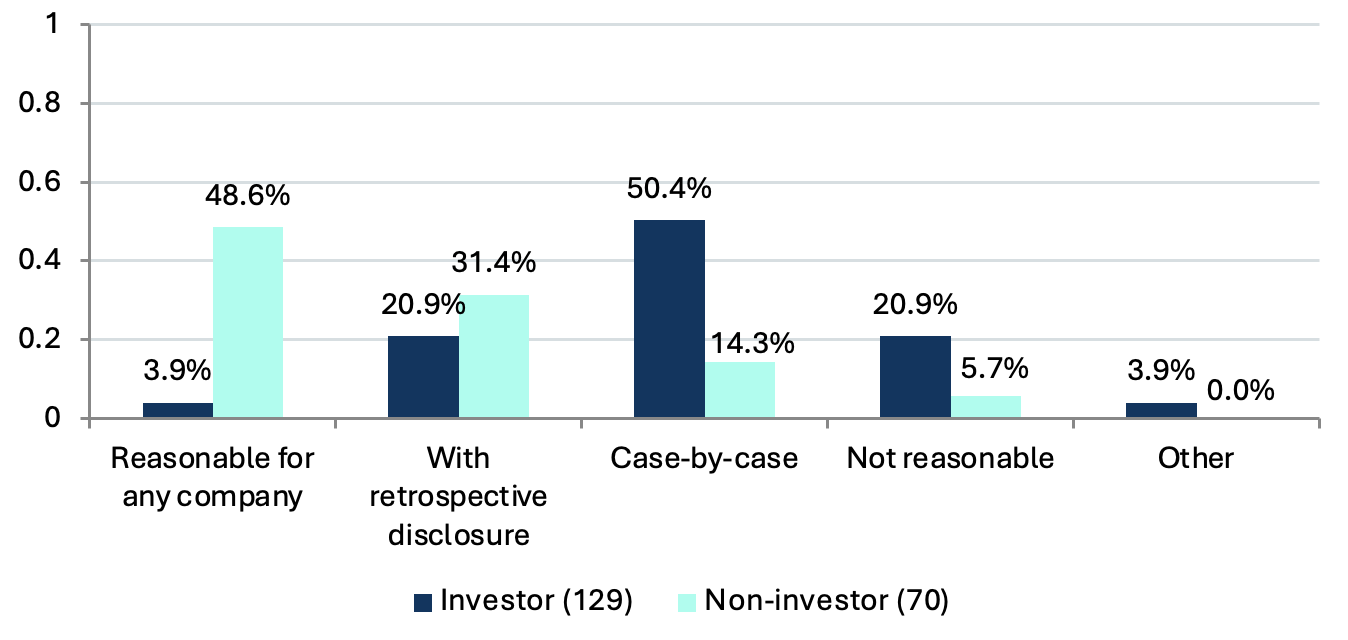
Investors were also considerably more skeptical of competitive harm arguments when companies withhold relative performance metrics rather than absolute performance targets, with nearly 80% of respondents supporting a distinction between the two.
Figure 3: Non-Disclosure of Relative Performance Metrics: Is Competitive Harm a Less Compelling Rationale?
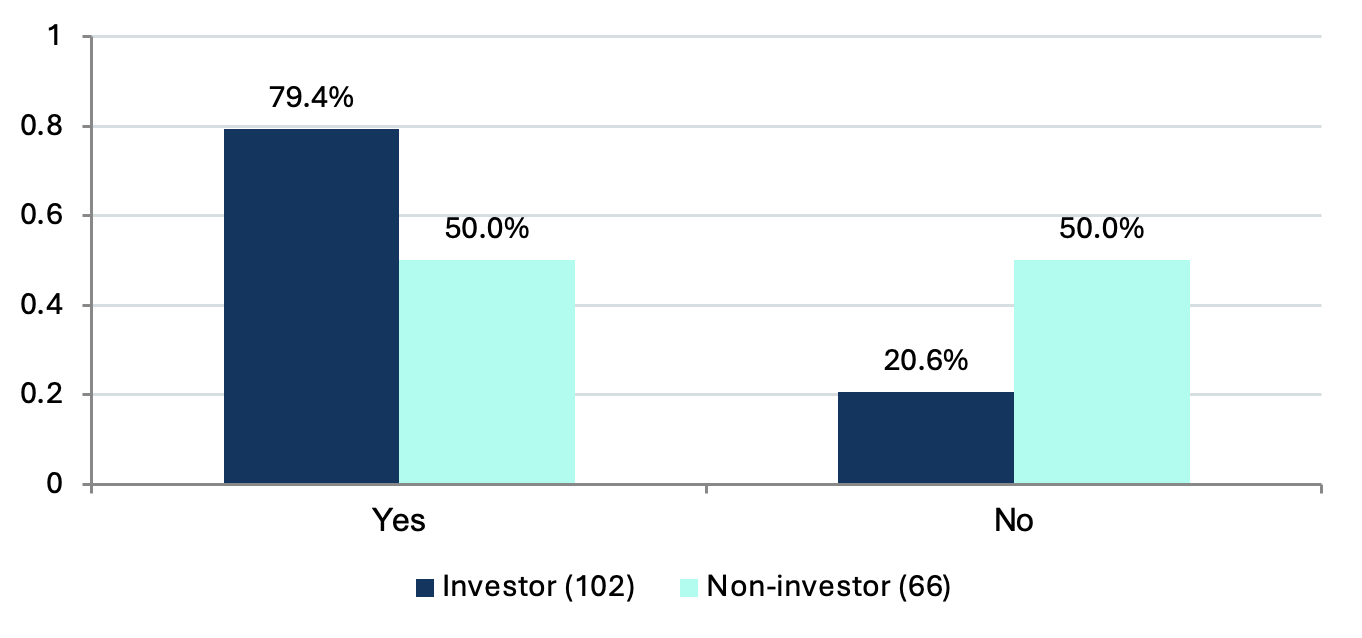
The findings suggest that investors continue to value transparency around incentive design, even where they may recognize legitimate commercial sensitivities
Say-on-Pay and Board Accountability
If say-on-pay vote exemptions are expanded, another question is how investors could express concerns regarding executive compensation when an advisory vote is no longer available.
Here again, the survey results point toward board elections as a potential avenue for accountability. Investor respondents largely favored maintaining some form of director accountability. While 41% supported directing concerns toward compensation committee members, 50% were in favor of a more targeted approach that would initially focus on the compensation committee chair and then escalate if concerns persist over multiple years. By contrast, most non-investor respondents answered that adverse voting recommendations would generally not be appropriate when companies are no longer required to provide a say-on-pay vote. In this respect, the shift would represent something of a return to the pre-say-on-pay framework of the 1990s and 2000s, when investors relied more heavily on votes against directors to express compensation-related concerns. Such votes provide a less targeted mechanism for signaling compensation concerns, given the range of considerations that can influence votes on individual directors.
Figure 4: Addressing Compensation Concerns without a Say-on-Pay Vote
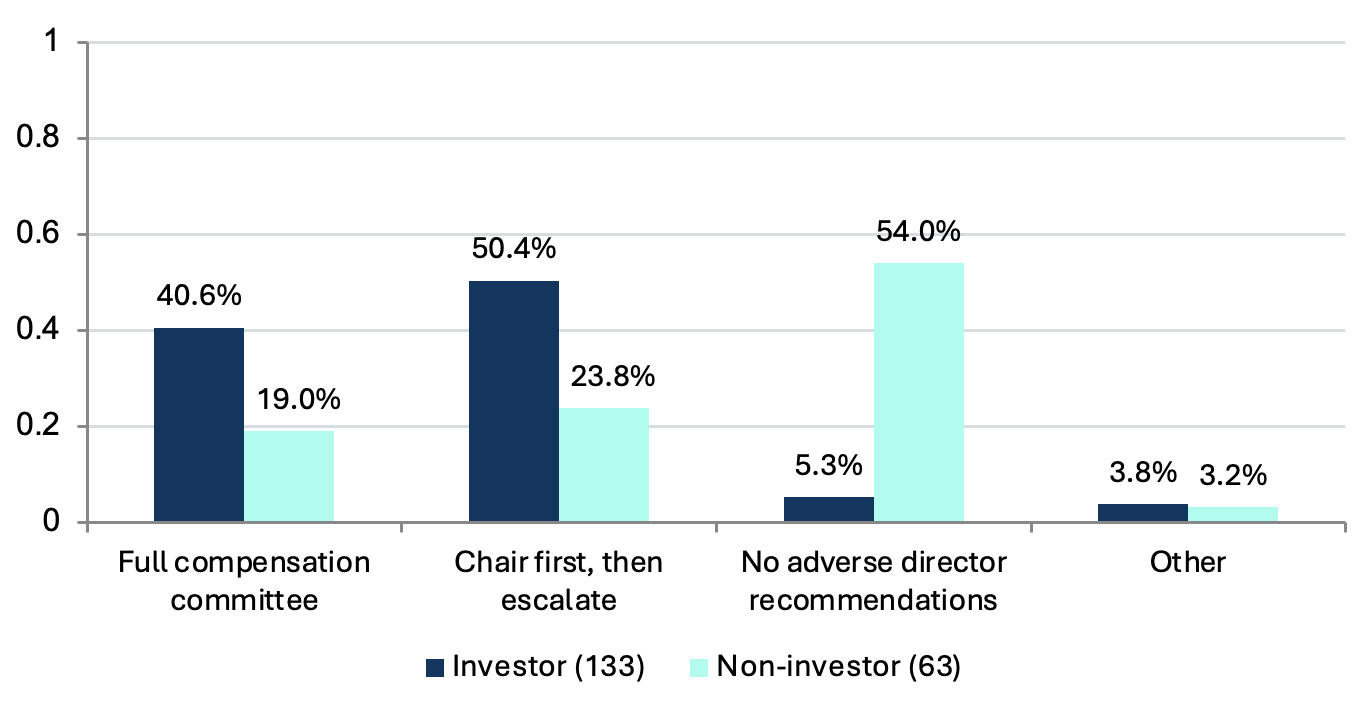
The results suggest that many investors view director elections as an important route for accountability if direct votes on executive compensation are unavailable. That raises some broader questions, including: if greater accountability is directed toward directors, how should investors assess the independence of the directors they are being asked to hold accountable?
Director Independence, Tenure, and Board Accountability
That question takes on broader significance in a governance landscape where shareholder proposals, exempt solicitations, and potentially even say-on-pay votes may become less available. If investors increasingly look to director elections as an avenue for accountability, questions surrounding director independence could take on greater importance.
The survey results on director tenure are particularly relevant in this context. Approximately 64% of investor respondents indicated that lengthy tenure should be considered when assessing director independence at U.S. companies, even though lengthy tenure alone is not generally treated as determinative of director independence in the U.S. market.
Figure 5: Director Tenure and Independence: Should Tenure Factor into Independence Assessments?
When asked about how tenure should be assessed (if they thought it should), respondents generally did not agree with a rigid, tenure-only standard. A majority preferred a broader assessment that incorporates factors such as board refreshment, tenure, and overlap with key board leaders, including the CEO and chair.
Figure 6: How Should Tenure Be Assessed?
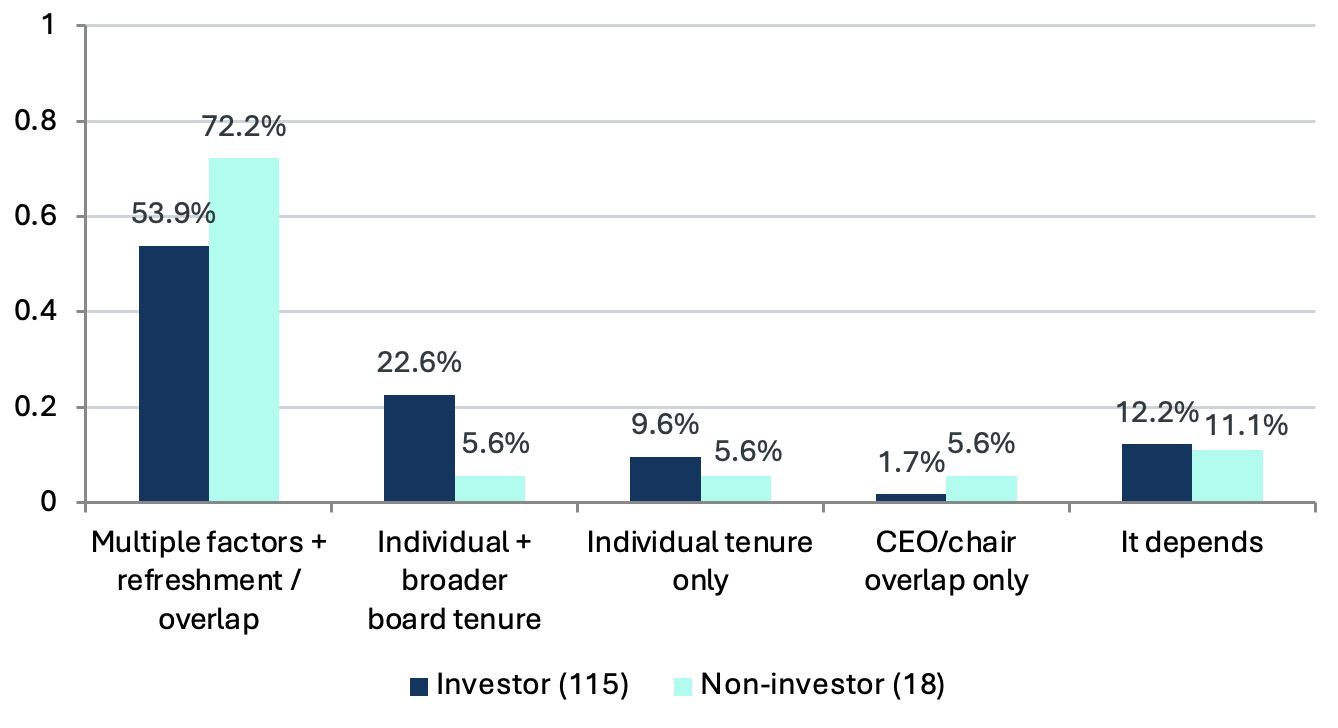
The findings suggest that many investors view independence as a contextual concept that should be assessed within the broader context of board oversight and composition.
Conclusion
Viewed together, the 2026 survey results provide a picture of how investors may be thinking about a governance framework in transition in the United States and, in particular, where they may look for accountability as that framework changes.
The survey results suggest that more limited or weakened shareholder rights and engagement mechanisms could change the ways in which many investors seek accountability and exercise their ability to engage through voting, rather than reduce the importance they put on these factors. Director elections and board oversight may consequently take on an even greater importance.
For investors, the challenge over the coming years may be less about adapting to any individual rule changes and more about reassessing where and how governance concerns can be escalated and expressed. As some long-established shareholder tools may become less available, greater attention may fall on director elections, board leadership, committee oversight, and assessments of director independence.
Authored By
ISS STOXX Governance
See More